

How to Interview & Hire the Right Camp Staff
February 11, 2026
Hiring the right people for the right roles at camp is harder than it looks. As a camp director or owner, staffing isn’t a seasonal task—it’s a year-round challenge. And when hiring goes wrong, the consequences show up fast: burnout, last-minute gaps, and inconsistent camper experiences.
Camp staffing leaders face a unique mix of challenges, including:
- High seasonal staff turnover
- Competing with other seasonal job options
- Reaching the right candidates early enough
- Evaluating applicants who may be new to the workforce—or to camp itself
Figuring out how to process and solve these pain points is half the battle.
That’s what we’ll tackle in this article.

Define the "Right Fit" Before You Start Hiring
Ask anyone with HR experience: clear role expectations attract stronger candidates. Even better, candidates who understand what’s expected from day one are far less likely to churn mid-season or after one summer.
Before you review a single application, align your leadership team around a clear hiring framework.
Start by deciding:
- What behaviors define success at your camp?
- Which traits matter most by role? (for example, counselors vs. support staff)
- What non-negotiables must every hire bring? (energy, reliability, communication)
"Good fit” shouldn't be left up to gut instinct on either side of the table. Outline the traits each role requires and be honest about what your camp offers in return. That clarity needs to exist before you post jobs or start reviewing applications.
You don’t need a perfectly detailed job description for every role. But your interviewers do need to know exactly who they’re tasked with hiring and how to recognize and appeal to strong candidates when they appear.
🎬 TAKE ACTION: Meet with team leads and returning staff regularly to identify the hard and soft skills that drove success in past seasons. Use those insights to shape your job postings, application questions, and interviews—so every candidate is evaluated through the same intentional lens.
The result?
Faster decisions, better hires, and a stronger edge against other summer opportunities competing for the same talent.
How the Right Camp Staffing Strategy Solves Common Camp Problems
When you hire with intention and align on what “right fit” truly means, here’s what changes:
✅
Fewer mid-season staffing emergencies
thanks to more reliable hires.
✅
Stronger, more consistent camper experiences with staff who stay engaged.
✅
More confident task delegation from leadership teams who trust their hires.
✅
Less burnout for directors and admin staff juggling fewer last-minute issues.
And it all starts with building the right hiring process from the ground up. Keep reading for tips on how to get started!

What Information & Questions to Include on a Summer Camp Staff Application
Hiring for summer camp is different. You’re not always recruiting for one specific role—you may be hiring counselors, activity leaders, lifeguards, and support staff from the same applicant pool.
💡 That raises an important question: how do you screen for the right people before interviews begin?
Your application should do more than collect information. It should help your team quickly identify candidates with the potential to succeed in different camp roles.
Start with the Basics (Applicant Bio)
These are
essential details
to have, but they’re only the starting point:
- Basic information (name, age, location, education)
- Certifications (CPR, lifeguarding, licenses)
- Relevant experience (work, volunteer roles, activities)
- Availability (full year, full summer, partial summer)
- References (reputation checks)
Screen for Fit & Potential
Unfortunately, due to the young age of many summer camp applicants, the certifications, experience, and references area of their resume can be slim. You need to look deeper.
To move from interviewing everyone who applies to interviewing the right people, your application needs questions that reveal instincts, values, and motivation.
Ask Applicants About Core Values
For example, how do candidates approach problem-solving? Do they act quickly or think things through? There’s no single “right” answer—but different roles may call for different instincts. Value-based questions help you sort candidates where they’re most likely to thrive.
Evaluate Communication & Leadership Skills
Strong communication is critical at camp. Use scenario-based questions to uncover how applicants handle conflicting instructions, teamwork challenges, or tense situations. Training can refine skills—but it’s far easier to build on natural aptitude than to start from scratch.
Figure Out Why the Candidate Applied
Are they a former camper? Referred by a friend or staff member? Looking to build skills or fill a seasonal role? Motivation matters. Knowing why someone applied helps you assess cultural fit and long-term engagement.
💡 You already evaluate these qualities during interviews. The question is: why wait? By incorporating them directly into your application, you save time, reduce hiring fatigue, and enter interviews focused on candidates with real promise.
How to Design & Conduct Fair, Effective Camp Staff Interviews
Staffing a camp is one of the toughest leadership challenges you face. From sorting through applicants to preparing staff for homesick campers, health concerns, and long days of high-energy programming—camp work isn’t for everyone. That’s why who you hire matters.
One of the most impactful steps you can take is building an interview process that’s fair, relevant, and structured—one designed to assess how candidates will perform in unpredictable, real-world camp situations.
At its core, an effective interview process comes down to two things:
1️⃣ Asking every candidate the right questions.
2️⃣ Capturing responses clearly and consistently in real time.
How to Choose the Right Summer Camp Interview Questions
A thoughtful interview isn’t just about ticking off boxes—it’s about learning how a candidate thinks, reacts, and behaves in situations they’re likely to face on the job.
In an article on interviewing skills for camp professionals, the American Camp Association recommends asking behavioral and competency-based questions that encourage candidates to explain real past decisions and actions, since past performance is one of the best predictors of future success.
Examples of strong behavioral or competency-based questions include:
- “Tell me about a time you had to manage a conflict with a peer.”
- “Describe a project or task that turned out to be much harder than you expected. How did you handle it?”
Asking these questions helps you assess how candidates manage stress, ambiguity, collaboration, and leadership. They’re qualities that matter enormously in a camp setting when caring for others, but often don’t show up on a resume.
💡 Why dive this deep before an interview? You’ll get a fuller picture of each applicant’s potential fit for your camp culture and expectations, so you can prioritize resources for the best candidates.

How Capturing the Right Interview Details Leads to Better Camp Hiring Practices
Even after narrowing your applicant pool, you’ll likely interview far more candidates than roles available. After a long day of interviews, names and personalities can blur. That’s where great candidates can get lost.
💡 While some great hires don’t shine on paper, strong interview notes help you remember why a candidate stood out. Capturing clear, consistent details turns interviews from fleeting impressions into reliable hiring decisions.
How to Build a Structured Note-Taking System for Interviews
Great interviews only work when they’re supported by strong systems. Without consistent documentation, decisions often rely on memory, instinct, or bias instead of evidence.
Here’s a simple, effective approach:
1. Use a standardized scorecard for interviews.
Create a scoring system tied to core competencies like communication, responsibility, problem-solving, and teamwork. Score every candidate using the same criteria.
2. Take focused, meaningful interview notes.
Capture specific examples and phrases that show how candidates think and act—not just whether you like them. These notes make fair comparisons possible.
3. When possible, conduct interviews & debrief as a team.
Review interviews together to identify patterns and strengths across candidates. Structured notes keep conversations productive and decisions grounded—not gut-driven.
When interviews are structured and documented consistently, hiring decisions become clearer. Instead of relying on memory or instinct, your team can compare candidates fairly and move forward confidently, knowing you’ve chosen the best fit for your camp.
But managing applications, interviews, notes, and timelines manually? That’s where even the best process can start to break down.
Find the Right Tools to Collect Applications & Interview Candidates
If you’re thinking, “This sounds like a lot of moving parts,” you’re not wrong, especially when hiring competes with everything else on your plate.
That’s where the right tools make all the difference.
Structured camp management software like iCampPro’s staffing season workflows help bring your entire hiring process into one place. You can build and host applications, automate reference follow-ups, standardize interview forms and scorecards, and move candidates through each hiring stage with clear timelines and visibility.
💡The result? Less time chasing paperwork, fewer missed opportunities, reduced follow-ups needed, and more confidence in every hiring decision. By centralizing your staffing workflow, nothing slips through the cracks. Every candidate is evaluated using the same thoughtful standards that reflect your camp’s values.
🎬TAKE ACTION: Ready to simplify your camp hiring process?
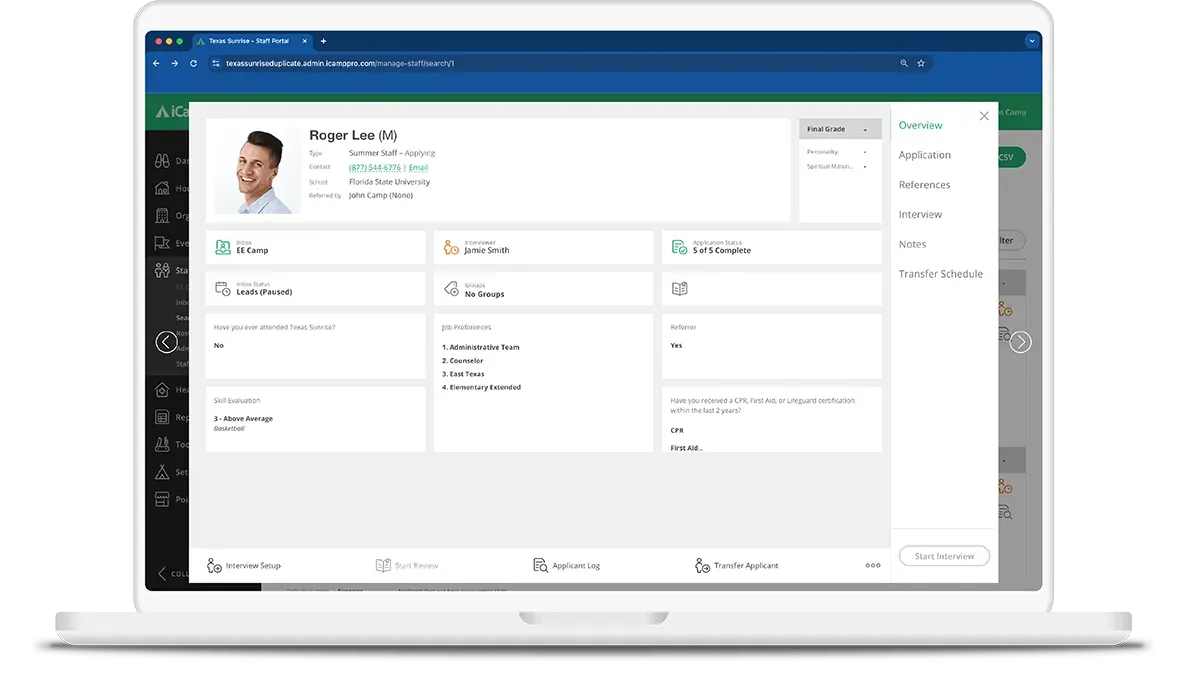
Connect with our team to see how iCampPro’s staffing tools support smarter, more efficient hiring from application to offer.
A Final Checklist for Smarter Camp Staffing
To recap, smarter camp staffing starts with:
✅ Prep your hiring process early.
✅ Involve past & current staff feedback.
✅ Update applications & interview questions annually to refine evaluations.
✅ Standardize interviews & scoring to hire farily and effectively.
✅ Streamline hiring workflows with the right tools to back your process.
Looking for more proven camp hiring tips?
Explore camp hiring FAQs and tips on how to get your application out there, how to get applicants across the finish line, and even more insights into what iCampPro has to offer in Camp Staffing Success: Recruitment & Hiring Tips That Work!