



Summer Camp Drop-Off & Pick-Up (Best Practices)
April 08, 2026
The difference between a good camp and an unforgettable one?
It’s not just creating good first impressions and hosting fun activities—it’s how you plan, structure, and execute the experience.
A camp’s first impression at drop-off shapes expectations for the entire experience.
But more than that, the experience shapes how families evaluate your professionalism, your safety, and your staff—at every single event.
Before campers know the schedule…
Before they meet their new camp bestie…
Before they try archery or jump in the water…
They decide how they feel about your camp based on first impressions.
And parents decide whether to trust you with their child.
That first interaction when they pull up doesn’t just set the tone for the day.
It’s the start of their story about your camp.
Why Do Camp Drop-Off & Pick-Up Experiences Matter?
Camp drop-off and pick-up aren’t just logistics.
They’re important trust-building moments.
These transitions influence:
- Parent confidence
- Camper comfort
- Staff energy
- Retention and referrals
- Perceived safety and professionalism
For many families, this is the only part of your operation they see.
These moments become their lens for everything else.
When it runs smoothly, it builds confidence.
When it feels chaotic, it raises questions—even if the rest of your program is exceptional.
That’s why great camps don’t leave these moments to chance. They design them.
Fast Article Navigation
Use these links to jump to the section you're interested in!
- Where Summer Camp Check-In Falls Apart
- Why Do Camp Drop-Off & Pick-Up Feel So Chaotic?
- Balancing Speed, Safety, & Experience at Camp
- 5 Common Drop-Off & Pick-Up Problems (& What Causes Them)
- Is Your System Working or Breaking Under Pressure? (Self-Assessment)
- How Camps Can Improve Drop-Off & Pick-Up (4 Proven Pillars)
- Make a Great First Impression Repeatable
- 3 Quick Wins to Improve Operations Now
- How Camp Software Improves Camp Drop-Off & Pick-Up
- Common Camp Drop-Off & Pick-Up FAQs

Here's Where Summer Camp Check-In Falls Apart
Summer camp runs on carefully crafted moments.
For many camps, arrival is part of the experience with decorations, music playing, staff cheering, counselors high-fiving, directors greeting families.
Every detail reinforces one message: You belong here.
But behind that moment?
A car line stretches down the road. 🚗
A parent needs a last-minute change. 📝
A staff member isn’t sure what to do. 😕
Walkies buzzing. 📢
The line slows and then stops. ⛔
Families aren’t just experiencing your camp culture.
They’re evaluating your systems and the way you manage them.
When drop-off feels disorganized:
❌ Safety feels uncertain
❌ Staff confidence drops
❌ Campers feel the stress
❌ Parent trust takes a hit
Because in high-pressure moments, perception shifts quickly.
Parents wonder: If this feels disorganized… what else is?
It’s not a staffing problem.
It’s a system design problem.
Why Do Camp Drop-Off & Pick-Up Feel Chaotic?
Camp drop-off can feel chaotic when your systems don’t handle real-world situations. These include heavy traffic, last-minute changes, and unclear team workflows.
It can also be thrown off by a lack of staff training and coordination.
Bottom line? Don’t leave your first impressions or send-offs up to chance.
Design those moments carefully and implement systems to support the ideal experience from day one.
Balancing Speed, Safety, & Experience at Camp
Aren't speed, safety, and experiences competing priorities?
No. A well-designed camp system can deliver fast, safe, and positive drop-off and pick-up experiences at the same time.
Arrival at camp and camper release are emotional intersections.
Excitement, nerves, logistics, safety, and timeline pressure all collide in one place.
It can feel like you have to choose:
- Faster lines or better safety
- Personalization or consistency
- High energy or control
But the best-run camps know that these aren’t trade-offs.
They’re manageable challenges in process design.
When designed well, they create:
- Calm, confident families
- Smooth, efficient flow
- Consistent safety practices
- A positive tone for the entire day
When these moments are intentional, they build loyalty. When they’re chaotic, they quietly erode trust; even if the rest of your camp program is exceptional.
5 Common Drop-Off & Pick-Up Problems (& What Causes Them)
Even experienced camps run into friction. Moments of friction are natural. It's not because they don’t care or made bad decisions. It's because even small operational gaps get exposed under pressure.

1. Last-Minute Changes & Paperwork Confusion
“Change of plans. Aunt Sarah is picking up instead.”
If updates aren’t centralized and visible, staff scramble. Lines stall. Stress rises.

2. Complex Scenarios Create Exceptions
Multiple campers with one parent. Two different age groups. One will need extended care. Another early pickup.
Simple systems break quickly when real-life complexity hits.

3. Staff Relies on Memory
Personalized experiences are important. But expecting staff to memorize names, faces, and details creates unnecessary pressure.
Personalization should be supported by systems, not rely on memory.

4. Inconsistent Pick-Up Verification Steps
Familiar faces can mean staff taking shortcuts.
“I know him—he always picks up.”
But what if something changed?
Safety systems should protect against exceptions, not rely on routine.
In a crisis hotline article from 2021, the American Camp Association urges camps to consult legal professionals. These professionals should know the laws in your jurisdiction.
Under their guidance, camps should design pickup procedures to navigate situations like shared custody. Then train staff to use those policies at all times.

5. End-of-Day Uncertainty
“Wait… did Ava already leave?”
“Who picked up Jacob?”
If you can’t quickly search and answer who is still on-site and who picked up a camper, your system is adding risk.
Smoothly addressing these points of friction requires careful planning.
Interested in how our tools can support your operations?
Find more details about attendance tools on last month's blog.
Is Your System Working or Breaking Under Pressure?
If your drop-off or pick-up process relies on memory, causes delays, or creates confusion, it likely needs redesign.
Do a Self-Assessment
If you’re seeing this… → It likely means this…
Lines backing up → Your traffic flow can’t handle peak volume
Staff asking a lot of questions → Roles and protocols aren’t clearly defined
Pickup confusion → Information isn’t centralized or up to date
Parents getting frustrated → Instructions weren’t clearly communicated

How Camps Can Improve Drop-Off and Pick-Up (4 Proven Pillars)
Smooth systems don’t happen by accident. They’re thoughtfully created.
These pillars address common friction points your camp team can plan ahead for.
Pillar 1: Set Expectations Before Families Arrive
Confident families move through lines faster.
Calm arrivals start before anyone gets in the car.
Define:
- Arrival and departure windows
- Step-by-step procedures
- Pickup authorization policies
Reinforce with:
- Maps and directions
- FAQs
- Reminder emails or texts
Clear communication reduces confusion and speeds up your entire process.
Steal Our Quick Checklist for Setting Expectations:
- Directions and map shared at registration
- Check In/Check Out policies clearly outlined online
- Instructions sent via email or text 3–5 days in advance
- A reminder sent the night before
Pillar 2: Design Better Camp Traffic Flow
Your traffic flow should absorb energy—not fight it.
Strong camp traffic flow systems:
- Minimize decision points
- Separate exceptions from the main line
- Keep cars moving consistently
What this looks like:
- Clearly marked lanes (by age group, number of campers, etc)
- Staff positioned ahead of check-in to guide and engage
- A designated “exception lane” for changes or questions
When flow improves, everything improves:
- Wait times drop
- Staff stress decreases
- Families feel more confident
Your traffic flow has a direct impact on the emotional experience of staff and families.

Pillar 3: Improve Camper Safety by Being Consistent
Safety improves when processes are consistent.
Standardize:
- Approved greetings/welcomes
- Camper & guardian lookup/verification
- Instructions for parking, lines, & unloading
- Exception handling for more complex scenarios
⭐ Quick Tip: Script your staff. When everyone uses the same language and delivers the clear information, lines move faster and confusion disappears.
Pillar 4: Clearly Defined Staff Roles Create Smooth Processes
Undefined roles create hesitation. Everything slows down.
Assign clear staff responsibilities:
- Greeter
- Verifier
- Runner
- Exception Lead
- Camper Support
Then close each day by:
- Reconciling attendance
- Confirming every camper is accounted for
- Gathering quick staff feedback
Remember:
Strong systems can improve daily, not just seasonally.
Make a Great First Impression Repeatable
The goal isn’t just a great first day. It’s having a great day every day.
When drop-off and pick-up are intentionally designed:
✅ Lines move faster.
✅ Staff stay calmer.
✅ Parents feel confident.
✅ Campers feel secure.
That magical first impression becomes:
Repeatable.
Predictable.
Scalable.
Never accidental.
3 Quick Wins to Improve Camp Operations Now
You don’t need a full system overhaul to see immediate improvement.
1. Create an Exception Lane of Traffic
Give families with last-minute changes a place to pull out of the main flow.
2. Script How to Move Problem-Solving Out of the Line
Train staff to say: “Let’s pull you forward so we can help without holding up the line.”
3. Practice & Train Staff on Handling Common Interactions and Disruptions
Provide exact language for greeting, verifying info, and managing changes.
These scripts dramatically reduce delays and stress.
Practice makes them feel more natural.
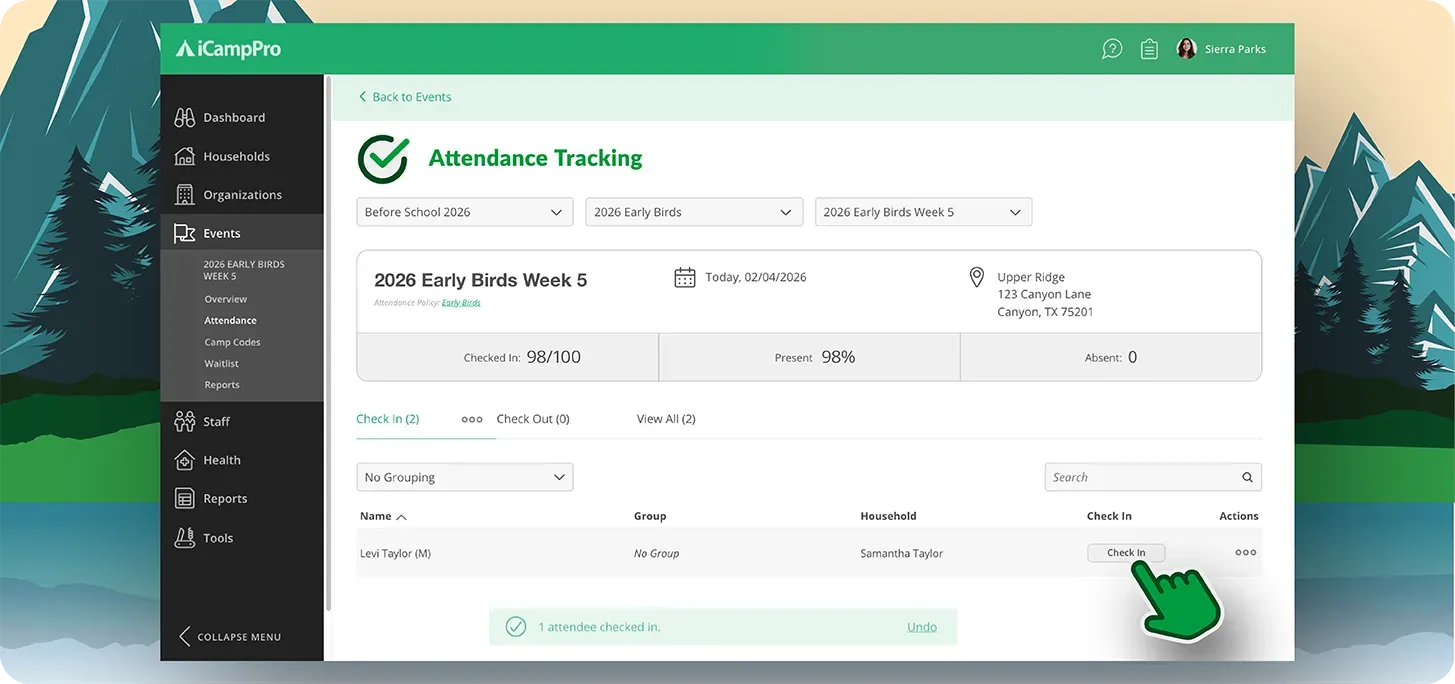
How Camp Management Software Improves Drop-Off & Pick-Up
Even the best camps and systems need the right tools backing them up.
Camp management software helps by:
- Centralizing camper and pickup data
- Providing real-time attendance visibility
- Verifying authorized guardians instantly
- Managing last-minute changes without confusion
This reduces:
- Reliance on memory
- Manual errors
- Line delays
So staff can focus LESS on logistics and MORE on the camper experience.
Drop-off and pick-up don’t have to be chaotic.
With the right systems, they become fast, safe, and confidence-building.
In short: Great camp drop-off and pick-up experiences depend on clear communication and good design. They also require consistent training and systems that support staff.
Common Camp Drop-Off & Pick-Up FAQs
How can camps make drop-off and pick-up faster?
Create clear traffic flow, communicate instructions in advance, assign staff roles, and move exceptions out of the main line. Lane sorting and early check-in points help keep lines moving.
What is the best way to manage camp pick-up?
Verify authorized guardians every time using a centralized system and standardized procedures. Avoid relying on memory.
How do you reduce long car lines at camp drop-off?
Use separate lanes for common scenarios, post clear signage, and send proactive communication. Designate an area for questions or changes to keep the main line moving.
How can camps improve the parent experience during drop-off?
Provide a smooth, predictable process with clear communication, minimal wait times, and friendly staff.
Should camps use technology for check-in and pick-up?
Yes! Technology improves accuracy, efficiency, and visibility into camp attendance, pick-up, and camper safety. Read more about iCampPro’s Attendance Tracking features.
How are drop-off and pick-up experiences related to camper retention?
They are often the only parent touchpoint with your operations. A smooth process builds trust; a chaotic one can lead to complaints, walk-offs, and lower retention rates.